Sourcing products for a physical therapy clinic sounds simple at first.
In reality, many clinics quickly realize it involves more moving parts than expected.
From product selection to pricing, branding, and logistics, sourcing decisions can affect both patient experience and clinic operations. For small and mid-sized clinics in particular, these challenges often arise when they start expanding beyond basic equipment.
Below are some of the most common issues clinics face when sourcing rehab and recovery products.
Unclear Product Selection
One of the first challenges is simply knowing what to choose.
There are many similar-looking products on the market, but not all of them are suitable for clinical use or home exercise programs.
Clinics often struggle with questions like:
- Which products do patients actually use at home?
- What level of quality is appropriate for rehab use?
- Which items are worth stocking versus recommending?
Without clear guidance, product selection can easily become inconsistent.
High Minimum Order Quantities
Many manufacturers require large minimum order quantities (MOQs), especially for customized or branded products.
This creates a problem for smaller clinics that want to:
- Test products before committing
- Avoid overstocking
- Control cash flow
- Start with limited patient programs
In practice, small-batch ordering is often used as a way to test real demand, not just assumptions.
On paper, a product may look like a strong fit for patients. But once it is actually used in a clinic, the results can be very different.
Some items that seem popular during selection are used less often than expected. Others, which look simple or low priority at first, end up becoming core tools in daily patient programs.
Small initial orders help clinics see how patients actually respond before committing to larger volumes.
High MOQs often force clinics to choose between taking unnecessary risk and delaying rollout altogether.
Inconsistent Quality Across Suppliers
Another common issue is quality variation.
Even similar-looking products can differ significantly in:
- Durability
- Material quality
- Ease of use
- Patient experience
For rehab products, small differences can have a big impact on usability and compliance. Clinics often need to test multiple suppliers before finding reliable options.
Branding Complexity
Adding clinic branding introduces another layer of complexity.
Different products may require different methods, such as:
- Logo printing
- Stickers or labels
- Packaging customization
- Instruction inserts
Each method has its own cost, MOQ, and lead time. Without a clear structure, branding decisions can become fragmented and difficult to scale.
Long and Unpredictable Lead Times
Lead times are often longer than expected, especially for custom orders.
Delays can come from:
- Sample approvals
- Design revisions
- Material availability
- Production scheduling
For clinics planning patient programs or campaigns, timing becomes a critical factor.
Inventory and Storage Constraints
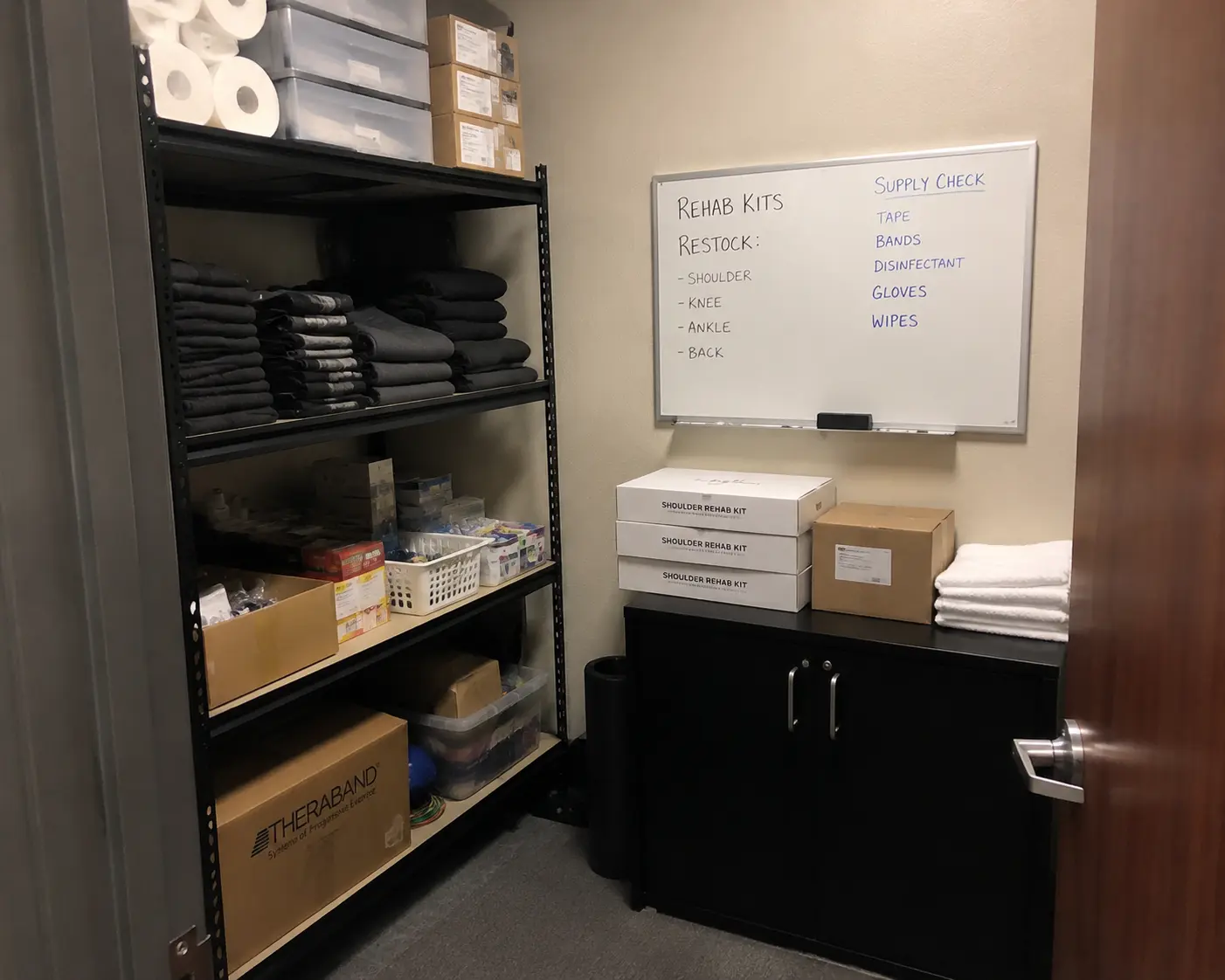
Many clinics operate with limited storage space.
Ordering too much product too early can lead to:
- Storage pressure
- Cash flow strain
- Slow-moving inventory
- Wasted materials if programs change
This makes demand forecasting particularly important but also difficult in practice.
Difficulty Aligning Products With Patient Needs
A key challenge is ensuring that sourced products actually fit patient behavior.
A product may look useful, but if it is:
- Too complex
- Hard to explain
- Not used during treatment sessions
- Or inconvenient at home
It often ends up underutilized.
Clinics need products that integrate naturally into both clinical sessions and home exercise programs.
Balancing Cost, Quality, and Flexibility
Most sourcing decisions involve trade-offs.
Clinics typically try to balance:
- Cost efficiency
- Product quality
- Branding flexibility
- Order volume risk
Finding the right balance is not always straightforward, especially for smaller operations without dedicated procurement teams.
Final Thought
Sourcing products for PT clinics is not just a purchasing task.
It is part of building a consistent patient experience.
The biggest challenges usually come from uncertainty—about products, volumes, suppliers, and outcomes.
Clinics that approach sourcing with simplicity, small tests, and clear patient use cases tend to reduce risk and improve long-term results.
In the end, the best sourcing decisions are neither the cheapest nor the most complex.
They are the ones that work reliably in real clinical practice.